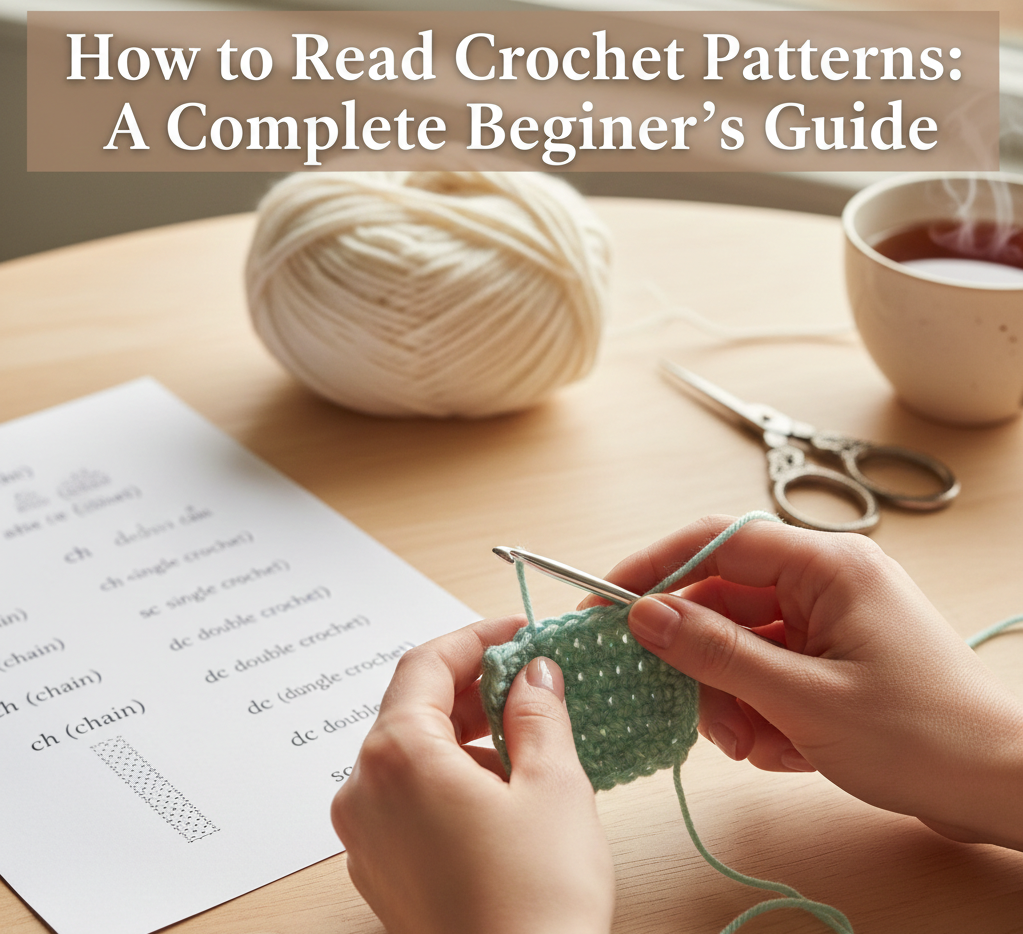
If you’ve just learned the basic crochet stitches and are excited to start your first project, there’s one skill that stands between you and thousands of beautiful patterns: learning to read crochet instructions. At first glance, a crochet pattern can look like it’s written in a foreign language, filled with mysterious abbreviations, confusing symbols, and instructions that seem to make no sense.
Here’s the truth: Once you understand the structure and language of crochet patterns, they become as easy to read as a recipe. That initial confusion? It’s completely normal, and every crocheter has felt it. The good news is that crochet patterns follow consistent conventions, so once you crack the code, you’ll be able to read virtually any pattern with confidence.
In this comprehensive guide, we’ll walk you through everything you need to know to read crochet patterns like a pro. Whether you’re interested in making amigurumi, blankets, garments, or accessories, this guide will give you the foundation to tackle any pattern that catches your eye. We’ll also explore the surprising cognitive benefits of learning this skill and why it’s worth investing time to master pattern reading rather than relying solely on video tutorials.
Why Learn to Read Written Crochet Patterns?
Before we dive into the how-to, let’s talk about why mastering pattern reading is such a valuable skill.
You’ll Unlock Thousands of Patterns
While video tutorials are wonderful learning tools, the reality is that the vast majority of crochet patterns exist only in written form. If you limit yourself to video-only patterns, you’re missing out on countless beautiful designs. Learning to read written patterns means nothing is off-limits – from vintage patterns passed down through generations to the latest designer creations.
It’s Faster Than Following Videos
Video tutorials require you to pause, rewind, watch sections multiple times, and often deal with ads or buffering. With a written pattern, you can instantly jump to any section, quickly reference specific rows or rounds, and work at your own pace without interruption.
You Can Crochet Anywhere
Printed patterns are completely portable. You don’t need WiFi, a charged device, or worry about balancing a tablet on your lap while trying to crochet. A simple printout or pattern book works anywhere – on the bus, in a park, at a coffee shop, or in your backyard.
You’ll Grow Your Skills Faster
Reading patterns teaches you stitch names, construction techniques, shaping methods, and how designs are structured. This deeper understanding makes you a more versatile and independent crocheter. You’ll start to understand why certain techniques are used and be able to modify patterns or even design your own projects.
The Cognitive Benefits Are Real
Research published in PMC (PubMed Central) and the Journal of Occupational Science demonstrates that learning and practicing crochet – including reading complex patterns – provides significant cognitive benefits. A study from 2025 found that even a single crochet session can improve attention and concentration, with the brain becoming more efficiently integrated as it processes pattern information.
According to the Lancet Commission (2024), 45% of dementia cases could be prevented by controlling modifiable risk factors, and engaging in cognitively stimulating activities like learning to read crochet patterns during mid-age is specifically recommended for maintaining cognitive health.
Research published in Perspectives in Public Health found that 89.5% of crocheters reported feeling calmer after crocheting, and 82% felt happier. Learning to read patterns enhances these benefits by keeping your brain actively engaged in problem-solving and spatial reasoning.
Understanding Pattern Structure: The Big Picture
Before getting into the details, let’s look at how patterns are typically organized. Most well-written crochet patterns follow a similar structure:
- Title and Description – What you’re making and what it looks like
- Skill Level – Whether the pattern is beginner, easy, intermediate, or advanced
- Finished Size – Dimensions of the completed project
- Materials List – Yarn type, amount, hook size, and other supplies needed
- Gauge – How many stitches and rows per inch (important for sized projects)
- Abbreviations and Special Stitches – Definitions of terms used in the pattern
- Notes – Important information about construction or techniques
- Instructions – The actual step-by-step directions
- Finishing – Assembly, weaving in ends, blocking, etc.
Let’s explore each section in detail.
Section 1: Skill Level
Every reputable pattern should indicate its difficulty level. This helps you choose appropriate projects for your current abilities.
Beginner/Basic: Projects for first-time crocheters using basic stitches, simple stitch repeats, and minimal shaping. Examples include basic scarves, simple dishcloths, or straightforward blankets.
Easy: Uses basic stitches with simple variations. May include easy color changes, basic shaping, and simple finishing work. Examples include granny square blankets, simple hats, or basic amigurumi.
Intermediate: Involves a variety of stitches and techniques, mid-level shaping and finishing. May include more complex color work, textured stitches, or garment construction. Examples include fitted sweaters, complex amigurumi, or intricate afghans.
Advanced/Experienced: Features intricate techniques, complex non-repeating patterns, multiple color changes, refined shaping, and detailed finishing. Examples include lace shawls, tailored garments, or complex tapestry crochet.
Important tip: Don’t be afraid to attempt a pattern one level above your current skill – that’s how you grow! However, starting three levels above will likely lead to frustration.
Section 2: Materials and Gauge
Materials List
This section tells you exactly what you need to complete the project:
Yarn: Specific brand and color used by the designer, plus yardage/meterage. You can substitute different yarns, but make sure the weight (thickness) matches. Yarn weights are standardized: lace (0), fingering (1), sport (2), DK (3), worsted (4), bulky (5), super bulky (6), and jumbo (7).
Hook Size: Listed in both US letter/number and metric measurements (e.g., “H/8 (5mm)”). The hook size affects the finished size and fabric drape.
Additional Supplies: May include stitch markers, tapestry needles, buttons, stuffing (for amigurumi), or other notions.
Gauge
Gauge indicates how many stitches and rows equal a specific measurement (usually 4 inches/10 cm).
Example: “Gauge: 14 sc and 16 rows = 4 inches in single crochet”
Why gauge matters: For sized items like garments, accurate gauge ensures your finished project matches the pattern dimensions. If your gauge is off, your sweater might be too small or too large.
For non-sized items like scarves or toys where exact dimensions don’t matter, gauge is less critical. However, it’s still helpful to match it reasonably closely.
How to check gauge: Crochet a 5×5 inch swatch in the pattern stitch, measure the center 4 inches, and count stitches and rows. Adjust your hook size if needed – larger hooks create looser fabric with fewer stitches per inch, smaller hooks create tighter fabric with more stitches per inch.
Section 3: Understanding Abbreviations
Crochet abbreviations are shorthand for stitch names and actions. They save space and make patterns easier to read once you know them.
Essential Stitch Abbreviations
ch – chain sl st – slip stitch
sc – single crochet hdc – half double crochet dc – double crochet tr – treble crochet (also called triple crochet) dtr – double treble crochet
Common Action Abbreviations
inc – increase (work 2 stitches in the same stitch) dec – decrease (combine 2 stitches into 1) sk – skip tog – together rep or repeat – repeat a sequence beg – beginning cont – continue foll – following prev – previous rem – remaining st(s) – stitch(es) sp(s) – space(s) lp(s) – loop(s)
Placement Abbreviations
BLO – back loop only FLO – front loop only yo – yarn over pm – place marker RS – right side (public-facing side) WS – wrong side (inside or back)
Critical note: US and UK crochet terms differ significantly. Most patterns specify which terminology they use. In US terms, “single crochet” exists; in UK terms, there is no “single crochet” – what Americans call “single crochet” is “double crochet” in UK terms. Always check which terminology the pattern uses!
Special Stitch Abbreviations
Patterns often include special stitches unique to that design. These will be defined in the pattern’s abbreviations section or notes.
Example: “Shell: (2 dc, ch 2, 2 dc) in same st or sp”
Pro tip: Print or write down common abbreviations and keep them beside you while you work. Eventually, you’ll memorize the most common ones.
Section 4: Decoding Pattern Symbols
Beyond abbreviations, patterns use punctuation and symbols to convey instructions efficiently.
Asterisks (*)
Asterisks indicate sections to repeat.
Example: “*Sc in next 3 sts, 2 sc in next st; rep from * around”
This means: Do the sequence between the asterisks (sc in 3 stitches, then increase in the next), then repeat that entire sequence all the way around the circle.
Multiple asterisks: Patterns sometimes use ** or *** to indicate nested repeats. Work from the inside out.
Parentheses ()
Parentheses group stitches that go into the same stitch or space.
Example: “(Dc, ch 2, dc) in next st”
This means: Work 1 double crochet, then chain 2, then another double crochet – all into the same single stitch below.
Example 2: “(Sc, hdc) in next st”
Work 1 single crochet and 1 half double crochet into the same stitch.
Parentheses can also indicate a sequence to repeat a specific number of times.
Example: “(Sc, dc) 3 times”
This means: Do the sc-dc sequence three times total (not three times each).
Brackets []
Brackets work similarly to parentheses but are sometimes used for clarity when parentheses are already present, or to group larger sections.
Example: “[Sc in next 2 sts, (dc, ch 1, dc) in next st] twice”
Do everything inside the brackets two times.
Note: Some designers use brackets and parentheses interchangeably. Always read the pattern notes to understand the designer’s convention.
Stitch Counts
At the end of pattern rows or rounds, you’ll often see a number in parentheses or brackets.
Example: “Rnd 1: 6 sc in magic ring (6)”
The number in parentheses tells you how many total stitches you should have at the end of that round. This is incredibly important for keeping track and catching mistakes early.
Always count your stitches! Especially as a beginner, count at the end of every row or round. If your stitch count is wrong, you’ve made a mistake and need to find and fix it before continuing. Stitch count errors compound quickly and can ruin an entire project.
Commas and Semicolons
Commas separate different actions within a sequence.
Example: “Sc in next st, ch 1, sk next st”
Do three separate things: single crochet, chain 1, skip a stitch.
Semicolons separate different groups or mark major transitions in instructions.
Example: “Sc in each st around; join with sl st to first sc”
Complete the main instruction, then do the joining action.
Section 5: Reading Pattern Instructions
Now let’s look at how to read the actual instructions line by line.
Rows vs. Rounds
Patterns are worked either in rows (back and forth, creating flat fabric) or rounds (in a circle or tube).
Row-based patterns will number rows: Row 1, Row 2, etc. You turn your work at the end of each row unless told otherwise.
Round-based patterns will use “Rnd” or “Round”: Rnd 1, Rnd 2, etc. You typically don’t turn between rounds (you keep working in the same direction around the circle).
Foundation Chain
Most patterns begin with a foundation chain.
Example: “Ch 20”
Make 20 chain stitches. This creates the base you’ll work into.
Working Into the Foundation Chain
Example: “Row 1: Sc in 2nd ch from hook and in each ch across (19 sc)”
This means:
- Skip the chain closest to your hook
- Work a single crochet into the second chain from the hook
- Continue working single crochet into each remaining chain
- You should end with 19 single crochet stitches
Why skip stitches? The skipped chain(s) act as turning chains to raise your yarn to the correct height. Different stitches require different numbers of turning chains:
- Single crochet: ch 1 (doesn’t count as a stitch)
- Half double crochet: ch 2 (sometimes counts as first stitch)
- Double crochet: ch 3 (counts as first stitch)
- Treble crochet: ch 4 (counts as first stitch)
Understanding “Counts as a Stitch”
This is where beginners often get confused. The pattern will tell you whether turning chains count as a stitch.
Example for double crochet: “Ch 3 (counts as first dc), dc in each st across”
The ch-3 you just made IS your first double crochet. So you work your next dc into the second stitch (not the first stitch) of the row below.
At the end of the return row, you’ll work into the top of that ch-3, treating it just like a regular dc stitch.
For single crochet: “Ch 1 (does not count as st), sc in first st”
The ch-1 just lifts your yarn up but doesn’t count. You work your first sc into the first actual stitch of the previous row.
Common Pattern Sequences
Let’s break down some typical pattern lines:
Example 1: “Sc in each st across (20)”
Simple! Work single crochet in every stitch until you reach the end. You should have 20 stitches total.
Example 2: “*Sc in next 3 sts, 2 sc in next st; rep from * around (30)”
This is an increase round. For each repeat:
- sc in 3 stitches (no change)
- 2 sc in 1 stitch (this increases by 1)
Repeat this pattern all the way around. You’re adding stitches evenly, ending with 30 total.
Example 3: “[Dc in next st, ch 1, sk next st] 10 times”
For each of the 10 repeats:
- Double crochet in a stitch
- Chain 1
- Skip the next stitch
This creates an open, lacey effect.
Example 4: “*(Sc, hdc, dc) in next st, sl st in next st; rep from * around”
This creates a shell or petal pattern. In each repeat:
- Work sc, hdc, and dc all into the same stitch (creates a fan/shell)
- Slip stitch into the next stitch (brings you back down)
Repeat this sequence around the circle.
Section 6: Special Techniques and Terminology
Magic Ring (or Magic Circle)
Often abbreviated as “MR” or “magic ring.” This technique creates a tight, adjustable starting circle for working in the round. It’s especially popular in amigurumi.
Pattern notation: “Rnd 1: 6 sc in magic ring”
Make a magic ring, then work 6 single crochet stitches into it.
Working in Specific Loops
Normally, you insert your hook under both loops of the stitch below. Sometimes patterns specify working in only one loop:
FLO (front loop only): Insert hook under only the loop closest to you. Creates a ridge on the back.
BLO (back loop only): Insert hook under only the loop farthest from you. Creates a ridge on the front.
These techniques create textured effects or allow pieces to be joined in specific ways.
Chain Spaces
Pattern notation: “Dc in next ch sp” or “Shell in next ch-3 sp”
A chain space is the gap created when you chain stitches and skip stitches in a previous row/round. You work into the space under the chain, not into the actual chain stitches.
Increases and Decreases
Increase: Work 2 or more stitches into a single stitch. Pattern notation: “2 sc in next st” or “Inc in next st”
Decrease: Combine 2 stitches into 1. Pattern notation: “Sc2tog” (single crochet 2 together) or “Dec”
For sc2tog: Insert hook in first st, yo and pull through (2 loops on hook), insert hook in next st, yo and pull through (3 loops on hook), yo and pull through all 3 loops.
Section 7: Reading Amigurumi Patterns
Amigurumi (stuffed toys/animals) patterns have their own conventions worth noting.
Continuous Rounds
Amigurumi is typically worked in continuous spirals without joining. You need a stitch marker to mark the beginning of each round.
Pattern notation: “Work in continuous rounds (do not join).”
Common Amigurumi Abbreviations
inc – increase (2 sc in same st) dec – decrease (sc2tog) MR – magic ring st(s) – stitch(es) rnd – round
Typical Amigurumi Pattern Format
Rnd 1: MR, 6 sc (6) Rnd 2: inc x 6 (12) Rnd 3: (sc, inc) x 6 (18) Rnd 4: (2 sc, inc) x 6 (24) Rnd 5-10: sc in each st around (24) Rnd 11: (2 sc, dec) x 6 (18)
Translation:
- Rnd 1: Magic ring with 6 sc total
- Rnd 2: Increase in every stitch = 12 stitches
- Rnd 3: Sc in first st, inc in next st, repeat 6 times = 18 stitches
- Rnd 4: Sc in 2 sts, inc in next, repeat 6 times = 24 stitches
- Rnds 5-10: Work evenly (no increases or decreases) for 6 rounds
- Rnd 11: Sc in 2 sts, decrease, repeat 6 times = 18 stitches
This creates a sphere shape: increases make it grow, even rounds maintain size, decreases make it shrink.
Section 8: Common Beginner Mistakes to Avoid
1. Not Reading the Entire Pattern First
Always read through the complete pattern before starting. You might discover:
- A technique you don’t know yet (time to learn!)
- Assembly instructions that affect how you make individual pieces
- Special notes about yarn substitutions or modifications
- The project is more complex than the skill level suggested
2. Ignoring the Notes Section
Pattern notes contain crucial information like:
- Which terminology (US vs UK) is used
- Special stitches and their definitions
- Construction tips
- Suggested modifications
Skipping notes is like ignoring the “before you begin” section of IKEA furniture instructions – you’ll regret it later!
3. Not Counting Stitches
This is the #1 cause of project failure for beginners. Always count your stitches at the end of each row/round, especially when learning. If your count is off, find and fix the mistake immediately. Continuing with wrong stitch counts creates increasingly wonky results.
4. Mixing Up US and UK Terms
Accidentally using UK terms when the pattern is in US terms (or vice versa) creates completely wrong stitches and ruins projects. Always check which terminology the pattern uses.
5. Not Checking Gauge for Sized Projects
For anything that needs to fit (garments, hats, etc.), gauge is critical. Skipping the gauge swatch “to save time” often means redoing the entire project later.
6. Giving Up Too Quickly
Pattern reading gets significantly easier with practice. Your first pattern will feel slow and confusing. Your fifth pattern will feel much more natural. By your tenth, you’ll be reading patterns almost automatically.
Section 9: Tips for Pattern Reading Success
Start With Easy Patterns
Choose patterns specifically labeled “beginner friendly” or “easy” that include:
- Clear photos or illustrations
- Detailed stitch tutorials or video support
- Simple, repetitive construction
- Minimal special stitches
Use High-Contrast Yarn
When learning to read patterns, use light or bright colored yarn (avoid black, dark brown, or navy). Being able to clearly see your stitches helps tremendously when following instructions.
Keep a Notebook
Jot down:
- Stitch counts at the end of each row/round
- Any modifications you make
- Where you stopped if taking a break
- Notes about confusing sections
Use Multiple Tools
Don’t rely solely on written patterns. Complement them with:
- Photo tutorials of specific stitches
- YouTube videos for new techniques
- Stitch dictionaries for reference
- Online crochet communities for questions
Join a Community
Online groups like Reddit’s r/crochet, Ravelry forums, or Facebook crochet groups are incredibly helpful. Experienced crocheters love helping beginners understand confusing pattern sections.
Mark Your Place
Use:
- Highlighters to mark the row you’re working on
- Sticky notes to track your place
- Row counters (physical or app-based)
- Check marks beside completed rows
Learn Common Stitch Combinations
Many patterns use standard combinations:
- V-stitch: (dc, ch 1, dc) in same st
- Shell: multiple dc in same st (e.g., 5 dc in same st)
- Cluster: multiple stitches worked together at the top
- Popcorn: multiple dc in same st, removed from hook, then joined
Recognizing these combinations makes reading patterns much faster.
Section 10: Choosing Your First Pattern
For your first pattern-reading experience, look for:
Characteristics of great beginner patterns:
- Clearly labeled as “beginner” or “easy”
- Uses only basic stitches (sc, hdc, dc)
- Small size (finishes quickly)
- Has photo tutorials or video support
- Includes clear stitch counts
- Positive reviews from other beginners
- Support from the designer (responds to questions)
Excellent first pattern types:
- Simple dishcloths or washcloths
- Basic scarves with simple stitch repeats
- Easy amigurumi (small balls, simple shapes)
- Granny squares
- Simple beanies or headbands
Avoid as first patterns:
- Garments requiring exact fit
- Lace with complex stitch patterns
- Anything requiring advanced techniques
- Patterns without photos
- Patterns with unclear or missing information
The Cognitive Benefits of Pattern Reading
Research demonstrates that learning to read and follow crochet patterns provides measurable cognitive benefits beyond simply creating finished projects.
A 2025 study published in PMC (PubMed Central) found that crocheting (which inherently involves reading and following patterns) significantly improved attention and concentration. The study showed increased brain connectivity and better communication between different brain areas – functioning almost like cognitive training.
According to research published in Issues in Mental Health Nursing (2024), engaging with needlecraft like crochet has an overwhelmingly positive effect on mental health and general well-being. Benefits include reduced stress, improved mood, sense of purpose and accomplishment, social connection, and even relief from chronic pain.
The complexity of reading patterns – translating abbreviations, visualizing three-dimensional construction from two-dimensional instructions, and problem-solving when things don’t work as expected – all provide valuable cognitive stimulation. The Lancet Commission (2024) specifically recommends cognitively stimulating activities during mid-life to reduce dementia risk.
Furthermore, research shows that crocheters report feeling calmer (89.5%) and happier (82%) after crocheting sessions. The focused attention required to follow patterns creates a meditative state similar to mindfulness practices, reducing stress and anxiety.
Conclusion: You’re Ready to Start Reading Patterns
Learning to read crochet patterns is like learning any new language – it seems impossible at first, but suddenly it clicks and becomes second nature. The key is to start simple, be patient with yourself, and practice consistently.
Remember these essential points:
✓ Always read the entire pattern before starting ✓ Check which terminology (US vs UK) is used ✓ Count your stitches at the end of every row/round ✓ Don’t be afraid to reference abbreviation guides ✓ Start with beginner-friendly patterns ✓ Join communities for support ✓ Practice, practice, practice
Every pattern you complete makes the next one easier. Every abbreviation you encounter becomes more familiar. Every technique you learn expands your capabilities.
Pattern reading isn’t just about following instructions – it’s about understanding construction, developing spatial reasoning, exercising your brain, and ultimately gaining the freedom to create anything you can imagine.
So grab a beginner-friendly pattern, your favorite yarn, and the appropriate hook. Start with Row 1 or Round 1. Count your stitches. Reference abbreviations as needed. And remember: every expert crocheter started exactly where you are now, confused by their first pattern and wondering if they’d ever understand it.
You will. And sooner than you think.
Happy crocheting!
Scientific and Educational Sources
- Sebastiano, D. R., et al. (2025). Crochet increases attention through a requiring motor skill learning. PMC (PubMed Central). https://pmc.ncbi.nlm.nih.gov/articles