If you’re starting out in the world of crochet, you’ve probably already encountered an overwhelming array of tools, accessories, and fancy kits in craft stores. It’s easy to feel lost among so many options and, worse yet, to spend money on things you won’t actually use.
The good news? You don’t need all of that to get started. In fact, there are only a few essential tools you really need to have on hand to successfully create your first crochet projects.
In this article, we’ll talk clearly and directly about what these indispensable tools are, why you need them, and how to choose the best options for your budget and needs. Additionally, we’ll explore what science says about the benefits of learning to crochet – and you’ll be surprised at how much this activity can benefit your mental and physical health.
Why Start Crocheting?
Before we talk about the tools, it’s worth understanding why so many people are rediscovering this traditional craft. Recent scientific research demonstrates that crochet goes far beyond a simple creative hobby.
An international study published in the journal Perspectives in Public Health analyzed more than 8,000 people who crochet in 87 different countries. The results were impressive: 89.5% of participants reported feeling calmer after crocheting, and 82% said they felt happier. Many actively use this activity to manage mental health conditions, difficult life events such as grief, chronic illness, and pain.
Another study, conducted by Italian scientists and published in PMC (PubMed Central), found that a single crochet session can significantly improve attention and concentration ability. The study showed that crocheting increases brain connectivity and improves how different areas of the brain communicate with each other, functioning almost like cognitive training.
Furthermore, a comprehensive scientific review published in 2024 in the journal Issues in Mental Health Nursing analyzed 25 studies on needlecraft (including crochet) and concluded that these activities have an extremely positive effect on mental health and overall well-being. Benefits include reduced stress, improved mood, sense of purpose and accomplishment, social connection, and even relief from chronic pain.
According to the Lancet Commission (2024), one of the world’s most respected medical research entities, 45% of dementia cases could be prevented by controlling modifiable risk factors. Among the recommendations is the practice of cognitively stimulating activities during middle age – and crochet fits perfectly into this category.
In summary: learning to crochet isn’t just about creating beautiful pieces. It’s about taking care of your mental health, exercising your brain, and finding moments of peace amid the daily rush.
The 5 Essential Tools to Get Started
Now that you understand the benefits, let’s get to what really matters: what you need to have on hand to start today.
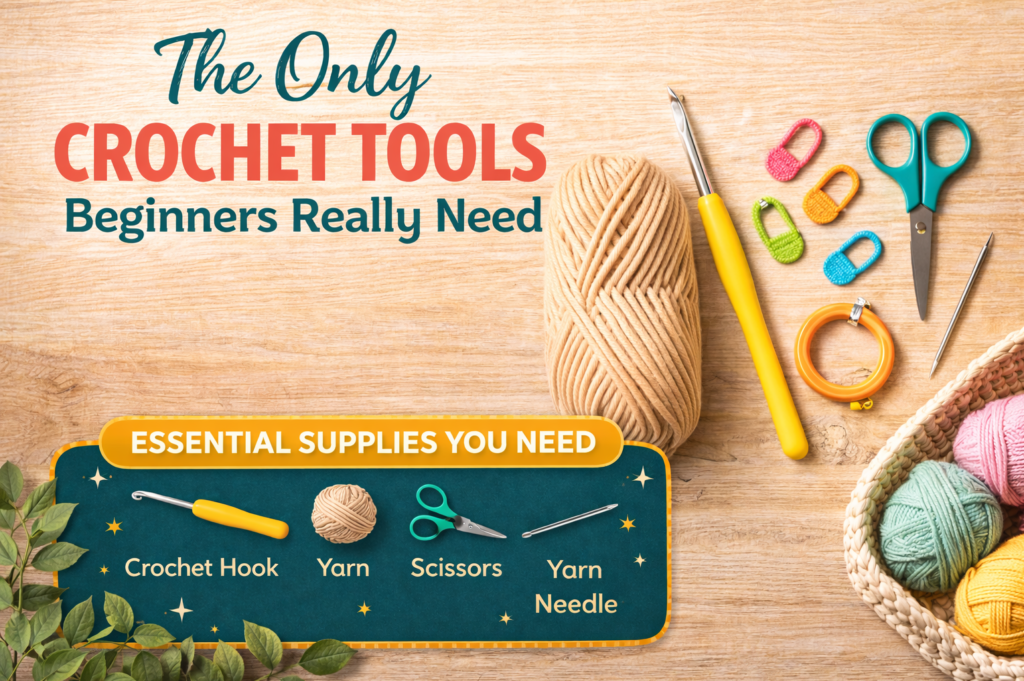
1. Crochet Hook
This is, without a doubt, the most important tool. Without it, crochet simply doesn’t exist. The crochet hook is that stick with a hook on the end that you use to pull the yarn and form stitches.
How to choose: Hooks come in different sizes, materials, and shapes. For beginners, the recommendation is to start with a medium-sized hook (between 4mm and 5.5mm or sizes G-6 to I-9 in US sizing), which works well with most yarns.
As for material, there are several options:
- Aluminum: They’re lightweight, glide smoothly through yarn, and are economical. Great for getting started.
- Plastic: Also cheap and lightweight, but can have more friction with the yarn.
- Wood/Bamboo: More comfortable for those with joint problems, but yarn slides less smoothly.
- Ergonomic: They have a special handle that reduces tension in hands and wrists. Ideal if you have arthritis or repetitive strain injury.
Practical tip: You don’t need to buy a complete set of hooks right at the beginning. Start with one or two medium-sized ones and, as you progress, add other sizes to your collection.
2. Yarn
After the hook, yarn is the second most important thing. And here there are also many options, but don’t be intimidated.
How to choose: For beginners, the ideal is a medium-weight yarn (weight 4 or “worsted weight”). These yarns aren’t too thin (where it’s hard to see the stitches) or too thick (which can tire your hands).
As for material:
- Acrylic: It’s the most popular choice for beginners. It’s inexpensive, comes in many colors, can be machine washed, and is easy to work with. Well-known brands include Red Heart, Lion Brand, Caron, and any acrylic yarn found in craft stores.
- Cotton: Great for kitchen items and baby items, but can be a bit more difficult to work with at first.
- Wool: Warm and soft, but can be expensive and requires special care when washing.
Practical tip: Start with acrylic yarns in light or medium colors (avoid black or dark brown at first, as it’s hard to see the stitches). A single skein of 300-400 yards is enough to make several small projects while you learn.
3. Scissors
You’ll need to cut yarn constantly – when finishing a project, when changing colors, or simply when weaving in ends. A small, sharp pair of scissors is essential.
How to choose: Any scissors you already have at home will work, as long as they’re sharp and comfortable to use. If you want to invest a bit more, embroidery scissors are perfect: they’re small, precise, and fit easily in your craft bag.
Practical tip: Keep your crochet scissors separate from other household scissors. This ensures they’re always sharp when you need them.
4. Tapestry Needle (or Yarn Needle)
This is a large, thick needle with a blunt tip that’s used to weave in the yarn ends that remain at the end of each project. It’s also used to sew separate pieces together when you need to join them.
How to choose: Look for tapestry needles with a large eye (hole) to easily thread the yarn. They can be metal or plastic – metal ones tend to last longer and glide better through stitches.
Practical tip: Buy a pack with different sizes. That way you’ll have the right needle for both thinner and thicker yarns.
5. Tape Measure
You’ll need to measure your projects to ensure they’re the right size – whether it’s a scarf, a hat, or any other piece.
How to choose: A retractable, flexible tape measure is the best option. It’s durable, easy to store, and can measure three-dimensional objects (like hats) without problems.
Practical tip: Prefer a tape measure that has centimeters on one side and inches on the other. Many crochet patterns, especially international ones, use inches as a measurement.
Extra Tools: Useful, But Not Essential
Now that you know the five indispensable tools, let’s talk about some items that can make your life easier, but aren’t absolutely necessary at the beginning.
Stitch Markers
These are small clips or rings that you use to mark specific stitches in your work – like the beginning of a row or where you need to make an increase.
When to use: They’re especially useful when you’re making projects in the round (like amigurumi or hats) or following complex patterns where it’s easy to get lost.
Free alternative: You can use paper clips, colored bobby pins, or even pieces of contrasting yarn to mark your stitches. Works perfectly well!
Row Counter
It’s a device (usually like a ring or a clicker) that helps track how many rows you’ve completed.
When to use: Useful in large projects where you need to make 50, 100 rows or more.
Free alternative: Use a small notebook, your phone’s notes app, or simply make tally marks on a piece of paper. Simple and effective!
Hook Organizer
A case or hook holder to store your tools in an organized way.
When to use: When you’ve already accumulated several hooks and accessories.
Free alternative: A pencil case or even a ziplock bag works perfectly.
What to Avoid When Starting: Common Mistakes
1. Buying Expensive Kits Full of Things
Many beginner kits come with dozens of items you probably won’t use in the first few months. It’s better to start with the basics and add tools as you feel the need.
2. Choosing Very Thin or Very Dark Yarns
Very thin yarns are difficult to maneuver for beginners, and dark colors make it impossible to see the stitches. Start with medium-weight yarns and light or vibrant colors.
3. Using the Wrong Hook Size
Each yarn has a recommended hook size (usually written on the yarn label). Using a hook that’s too small or too large will make your work too tight or too loose.
4. Not Practicing Regularly
Like any manual skill, crochet improves with practice. Research shows that people who crochet more than three times a week report feeling happier and calmer. Even if you practice just 15-20 minutes a day, it makes a big difference in your learning and well-being.
5. Trying Very Complex Projects Right Away
It’s tempting to want to make that super detailed amigurumi or that beautiful sweater you saw on Pinterest. But starting with very difficult projects can be frustrating. Begin with simple things like scarves, granny squares, or coasters. As you gain confidence, you can move on to more ambitious projects.
How to Learn Crochet: Free Resources
The best part about learning crochet nowadays is that you don’t need to pay for expensive classes. There are countless free resources available:
- YouTube: Has thousands of video tutorials, many in English, teaching everything from basic stitches to advanced techniques.
- Blogs and Websites: Many crafters share free patterns and step-by-step tutorials on their blogs.
- Online Communities: Facebook groups, forums, and platforms like Ravelry bring together millions of crocheters who share tips, answer questions, and offer support.
- Apps: There are free apps that teach basic stitches and help track your projects.
Research published in the Journal of Occupational Science highlighted that people who learn crochet through online communities report not only improvements in their skills, but also a sense of belonging and social connection – extremely important factors for mental well-being.
When to Invest in Better Tools
As you advance in crochet and start making more frequent or complex projects, it may be worth investing in better quality tools:
- Ergonomic hooks: If you crochet for long hours or have joint problems.
- Higher quality yarns: For special projects like gifts or pieces you want to last many years.
- Organizers and accessories: When your collection grows and you need better organization.
- Pattern books: To have a reference library always on hand.
But remember: none of this is necessary to start or to continue crocheting with pleasure.
The Benefits Continue as You Practice
Science is clear: the more you crochet, the more benefits you reap. A study from the University of California at Los Angeles (UCLA) explains that the constant and gentle movement of crochet can increase the release of serotonin, a neurotransmitter crucial for mood regulation, learning, sleep, and pain perception.
The meditative qualities produced by crochet can help people temporarily “forget” their mental and physical difficulties. Therapeutic crochet has been associated with combating depression, anxiety, post-traumatic stress disorder, substance abuse, eating disorders, and chronic pain.
Researchers have found that the repetitive and rhythmic activity of crochet allows your mind to move away from what’s bothering you, allowing you to focus on the repetitive movement. Before you know it, 30 minutes have passed, you’ve completed several rows, and you’re no longer thinking about what was stressing you out.
Conclusion: You’re Ready to Begin
Getting started with crochet is simpler than you think. With just five basic tools – hook, yarn, scissors, tapestry needle, and tape measure – you have everything you need to take your first steps in this incredible activity.
Don’t worry about having all the accessories in the world or making everything perfect from the start. Crochet is a journey of continuous learning, and every stitch you make is a small step forward.
Remember that you’re not just learning a new manual skill – you’re investing in your mental health, exercising your brain, developing your creativity, and, who knows, discovering a passion that will accompany you throughout your life.
So grab your basic tools, choose a simple tutorial, and start today. Your first project may not be perfect, but it will be yours. And every stitch you make is a step toward greater calm, happiness, and well-being.
Scientific Sources Consulted
Sebastiano, D. R., et al. (2025). Crochet increases attention through a requiring motor skill learning. PMC (PubMed Central). https://pmc.ncbi.nlm.nih.gov/articles/PMC11790931/