You’ve decided to learn to sew, and you’re excited to start. But when you start researching what you need, you’re quickly overwhelmed. Online searches return lists of 20, 30, even 50+ “essential” tools. Store aisles overflow with gadgets, notions, and specialty items you’ve never heard of. Suddenly, what should be a simple hobby feels expensive, complicated, and intimidating.
Here’s what nobody tells you: You need surprisingly few tools to start sewing successfully. In fact, with just 5-7 basic items, you can complete most beginner sewing projects beautifully. Everything else? Nice to have, but not necessary initially.
In this comprehensive guide, we’ll walk you through exactly which sewing tools you truly need, which ones are helpful but optional, and which expensive items you can skip entirely. You’ll learn budget-friendly shopping strategies, brand recommendations, and how to build your collection gradually without wasting money on tools you’ll never use.
Whether you have $50 or $500 to spend, this guide will help you create the perfect beginner sewing kit that sets you up for success.
The Essential 5: What You Absolutely Must Have
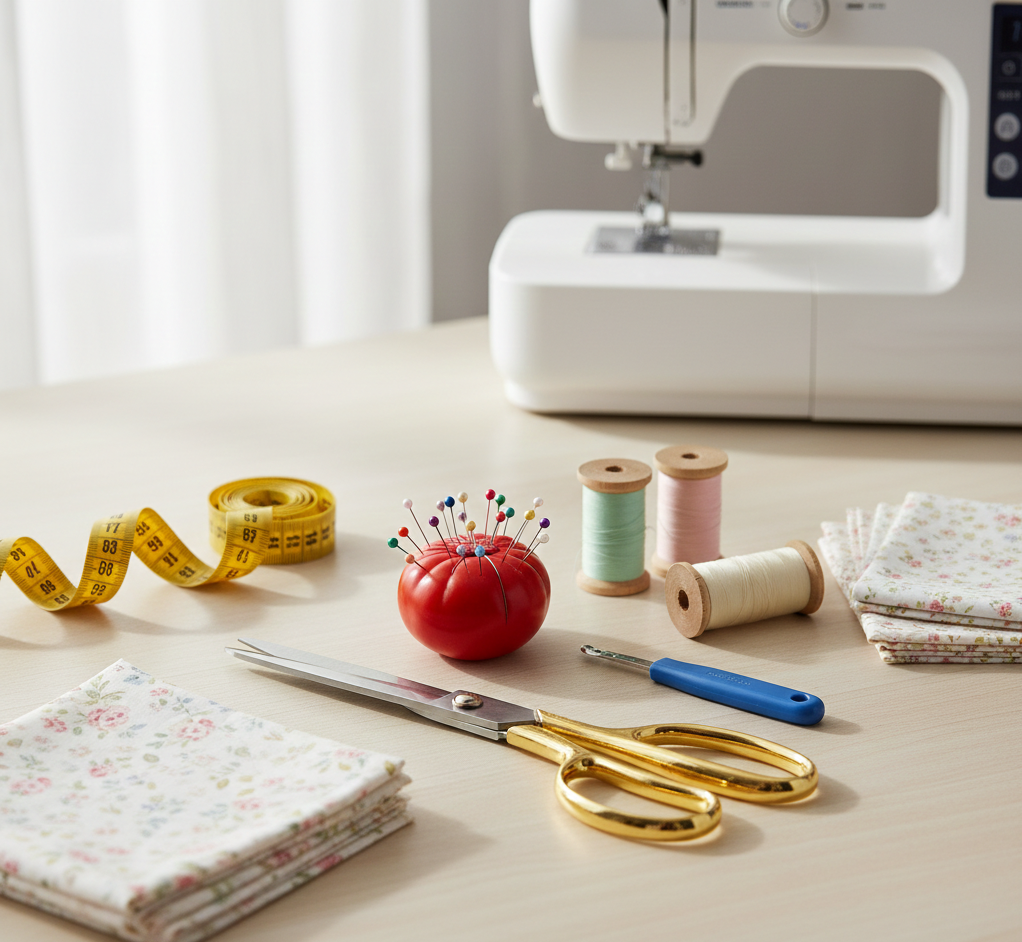
Let’s start with the non-negotiables. These five tools form the foundation of every sewing project, and you simply cannot sew without them.
1. Sewing Machine ($100-500)
Your sewing machine is the most significant investment, but also the most important tool in your sewing room.
What you need in a beginner machine:
- Straight stitch (essential)
- Zigzag stitch (very important)
- Adjustable stitch length
- Reverse stitch function (for backstitching)
- Basic presser feet included
What you DON’T need:
- 500+ decorative stitches
- Computerized touchscreens
- Embroidery capabilities
- Automatic everything
Budget options:
Option 1: Use What You Have ($0)
- Inherited machine from a relative
- Machine you already own
- Have it professionally serviced ($50-100) if it’s been sitting unused
Option 2: Buy Used ($50-200)
- Facebook Marketplace, Craigslist, estate sales
- Local sewing machine dealers (sell serviced trade-ins)
- Thrift stores (occasionally find working machines for $20-50)
Option 3: Buy New Entry-Level ($150-400)
Top beginner machine recommendations:
Brother CS7000X ($300-400)
- 70 built-in stitches
- Wide table included
- LCD display
- Excellent for beginners
Singer Heavy Duty 4423 ($250-350)
- Strong motor
- Fast stitching (1,100 spm)
- Metal frame (very durable)
- Simple, reliable
Janome 2212 ($200-250)
- Mechanical (not computerized)
- Excellent reputation for durability
- Easy to learn and use
Where to save money:
- Black Friday deals (save $100-200)
- Previous year models (30-50% off)
- Floor models from dealers (20-30% off)
- Costco, Walmart, Amazon (often cheaper than specialty stores)
2. Fabric Scissors ($15-50)
High-quality fabric scissors are a sewer’s best friend. This is one tool worth investing in quality.
What to buy:
- 8-10 inch fabric shears
- Sharp, precision blades
- Comfortable handles
- Dedicated ONLY to fabric (never paper!)
Budget-friendly quality brands:
- Fiskars ($15-25) – Excellent value, sharp, durable
- Gingher ($30-50) – Professional quality, lasts decades
- Kai ($40-60) – Beloved by sewists, super sharp
CRITICAL RULE: Use fabric scissors ONLY for fabric. One cut through paper permanently dulls the blade. Label them “FABRIC ONLY” if others might use them.
Pro tip: Buy decent scissors from the start. Cheap scissors ($5-10) frustrate you with jagged cuts and require replacement quickly. Quality scissors last 20+ years with proper care.
Additional scissors needed:
- Small embroidery scissors ($5-10) for detail work and thread trimming
- Paper scissors ($3-8) for cutting patterns (never use fabric scissors on paper!)
3. Measuring Tape ($2-8)
Accurate measurements are fundamental to successful sewing projects.
What to buy:
- Flexible, retractable tape measure
- 60 inches (150 cm) minimum length
- Shows both inches and centimeters
- Clear, easy-to-read markings
Where to buy:
- Any craft store: $3-5
- Dollar stores: $1-2
- Amazon: $2-5
Why it’s essential:
- Taking body measurements for garments
- Measuring fabric yardage
- Checking project dimensions
- Measuring hems and seam allowances
Alternatives you might already have: Standard tape measure, yardstick, or ruler work for some tasks, but flexible tape measures are essential for curves and body measurements.
4. Hand Sewing Needles ($2-5)
Even with a sewing machine, you’ll need hand sewing needles for finishing work, basting, and detailed tasks.
What to buy:
- Pack of assorted needles ($2-5)
- Include sharps (general purpose)
- Include embroidery needles (larger eye for thicker thread)
- Variety of sizes
When you’ll use them:
- Hand-basting before machine sewing
- Sewing on buttons
- Closing openings after turning
- Detail work your machine can’t reach
- Repairs and alterations
Budget tip: Multi-packs cost $2-5 and last years. Don’t buy expensive individual needles initially.
5. Thread ($15-30 for starter collection)
Quality thread matters more than you think. Cheap thread breaks easily, creates lint, and weakens seams.
What to buy for beginners:
- All-purpose polyester thread OR cotton-wrapped polyester
- 50-weight (standard weight)
- 4-6 spools in neutral colors:
- White or off-white
- Black
- Grey (light and dark)
- Beige/tan
Budget-friendly quality brands:
- Coats & Clark Dual Duty Plus ($3-4 per spool) – Great all-purpose thread
- Gütermann ($4-6 per spool) – Excellent quality, widely available
- Aurifil ($10-12 per spool) – Premium but worth it
Where to save money:
- Shop sales at Joann (frequent 50% off thread sales)
- Buy larger spools (better value per yard)
- Amazon often has multi-packs at good prices
What to avoid:
- Ultra-cheap thread ($1-2 per spool) – breaks constantly
- Very old thread – loses strength over time
- Single-purpose specialty threads until you need them
Total Cost for Essential 5: $135-600
- Sewing machine: $100-500
- Fabric scissors: $15-50
- Measuring tape: $3-8
- Hand needles: $2-5
- Thread: $15-30
Budget breakdown:
- Ultra-budget (used machine): $135-200
- Mid-range (new basic machine): $235-400
- Comfortable (quality new machine): $435-600
The Highly Recommended 7: Add These Next
Once you have the essential 5, these tools make sewing significantly easier and more enjoyable.
6. Seam Ripper ($2-10)
Every sewist – beginner to professional – makes mistakes. A seam ripper lets you remove stitches and try again.
What to buy:
- Ergonomic handle (easier to grip)
- Sharp point (gets under stitches easily)
- Protective cap
- Larger size (easier to find, more comfortable)
Budget options:
- Basic seam ripper: $2-3
- Ergonomic model: $5-10
Where to find:
- Most sewing machines include one
- Any craft store
- Dollar stores ($1-2)
Pro tip: Buy 2-3. They’re cheap, you’ll misplace them, and having backups prevents frustration.
7. Straight Pins ($5-15)
Pins hold fabric pieces together before and during sewing, ensuring accurate seams.
What to buy:
- Glass or plastic-head pins (won’t melt if iron touches them)
- Sharp points
- Pack of 100-250 pins
- Standard length (1-1.5 inches)
Budget-friendly brands:
- Dritz quilting pins ($6-10)
- Singer ball-point pins ($5-8)
- Generic craft store pins ($4-7)
Where to save:
- Dollar stores often have adequate pins for $1-3
- Amazon multi-packs offer good value
Storage tip: Magnetic pin cushion ($3-5) or pin box keeps pins organized and accessible.
8. Iron and Ironing Board ($30-100)
Pressing is absolutely essential in sewing. You’ll press fabric before cutting, press seams open after sewing, and press finished projects.
Budget options:
Use What You Have ($0)
- Your current iron and ironing board work fine for sewing
- Any iron that gets hot is adequate
If Buying New:
- Basic steam iron ($15-30) – Sunbeam, Black & Decker, Hamilton Beach
- Standard ironing board ($20-40)
What you DON’T need:
- Expensive steam stations ($200+)
- Specialty sewing irons ($100+)
- Enormous professional ironing boards
What you DO need:
- Iron that gets hot
- Steam function (or spray bottle + dry iron)
- Stable, sturdy ironing board
Pro tip: Many sewists use a spray bottle ($2) with water and a dry iron for more control. This prevents water spots and allows precise moisture application.
9. Seam Gauge ($3-8)
A small ruler with a sliding marker, perfect for measuring and marking consistent seam allowances, hems, and buttonhole placement.
What it does:
- Measures small distances accurately (1/4″ to 6″)
- Sliding marker remembers measurements
- Helps create consistent hems and pleats
Budget alternative: Standard ruler works, but seam gauge is more convenient for repetitive measurements.
10. Tailor’s Chalk or Fabric Marking Pen ($3-10)
You’ll need to mark fabric for darts, seam lines, button placement, and other construction details.
Options:
Tailor’s Chalk ($3-5)
- Traditional choice
- Comes in multiple colors
- Brushes off easily
- Lasts long time
Water-Soluble Marking Pens ($4-8)
- Easy to see
- Washes out completely
- Available in multiple colors
- Can disappear too quickly in humid environments
Heat-Erasable Pens ($5-10)
- Mark disappears when ironed
- Great for temporary markings
- Test on scrap fabric first
Budget tip: Start with basic tailor’s chalk. It’s cheap, reliable, and works on all fabrics.
11. Rotary Cutter, Mat, and Ruler ($30-70 for set)
While not absolutely essential, these tools make cutting fabric significantly faster and more accurate.
What to buy:
- 45mm rotary cutter ($10-20)
- 18″ x 24″ self-healing cutting mat ($15-30)
- 6″ x 24″ clear acrylic ruler ($10-20)
When they’re useful:
- Cutting straight edges quickly
- Cutting multiple layers at once
- Quilting projects
- Cutting lots of fabric pieces
Budget alternative: Fabric scissors work fine. Add rotary cutting tools later if you sew frequently.
12. Pincushion ($3-15)
Keeps pins organized and accessible while you work.
Options:
- Magnetic pin dish ($3-5) – Picks up dropped pins easily
- Traditional tomato pincushion ($3-8)
- Wrist pincushion ($5-10) – Wear on wrist while sewing
Budget alternative: Small container, jar, or tin works fine (FREE!).
Total Cost with Highly Recommended 7: $165-700
- Essential 5: $135-600
- Additional 7 tools: $30-100
Very Helpful But Optional: Add as Needed
These tools enhance specific aspects of sewing but aren’t necessary for beginners.
Pattern Weights ($5-20)
Hold pattern pieces in place while cutting instead of pins.
Budget alternative: Use heavy items you have (cans, jars, large washers).
Point Turner ($3-8)
Helps push out corners when turning items right-side out (bags, pillows).
Budget alternative: Use a chopstick, knitting needle, or pencil (with eraser end).
Sewing Clips ($8-15 for set)
Alternative to pins, especially useful for thick fabrics, vinyl, or multiple layers.
When they’re helpful:
- Holding thick layers (pins don’t penetrate)
- Vinyl/leather (pins leave permanent holes)
- Binding edges
Needle Threader ($2-5)
Helps thread hand sewing needles, especially helpful as eyes age.
Budget alternative: Use good lighting and patience (FREE!).
Thread Snips ($8-20)
Spring-loaded scissors specifically for cutting thread quickly.
Budget alternative: Small embroidery scissors work fine.
Thimble ($2-8)
Protects finger when hand sewing through thick fabrics.
When it’s useful: Hand quilting, sewing through multiple layers, extensive hand sewing.
Bodkin ($3-8)
Tool for threading elastic or cord through casings.
Budget alternative: Safety pin works perfectly (FREE!).
Walking Foot ($30-80)
Special presser foot that feeds multiple layers evenly, preventing shifting.
When you need it: Quilting, sewing with slippery fabrics, matching plaids/stripes.
Complete Beginner Kits by Budget
Let’s break down exactly what to buy based on your budget.
Ultra-Budget Kit: $50-100
What to buy:
- Used/inherited sewing machine (serviced): $50-100
- Basic fabric scissors: $15
- Measuring tape: $2
- Hand needles: $2
- 3 spools thread: $10
- Seam ripper: $2
- Basic pins: $5
- Total: $86-136
What you can make: Simple projects like pillowcases, tote bags, simple skirts, cloth napkins.
Standard Beginner Kit: $200-350
What to buy:
- Entry-level new machine: $200-300
- Quality fabric scissors: $25
- Measuring tape: $5
- Hand needles: $3
- 6 spools thread: $20
- Seam ripper: $5
- Quality pins with pincushion: $10
- Iron (if needed): $20
- Seam gauge: $5
- Tailor’s chalk: $4
- Total: $297-397
What you can make: Most beginner patterns including garments, home decor, bags, and quilts.
Comfortable Starter Kit: $400-600
What to buy:
- Quality beginner machine: $350-450
- Premium fabric scissors: $40
- Measuring tape: $8
- Hand needles: $5
- 10 spools thread: $35
- Ergonomic seam ripper: $8
- Quality pins and magnetic holder: $15
- Iron and board (if needed): $60
- Seam gauge: $8
- Marking tools (chalk and pen): $10
- Rotary cutter, mat, ruler set: $60
- Total: $599-699
What you can make: Virtually any beginner to intermediate pattern with professional results.
Where to Shop: Best Sources
For Budget Tools:
Dollar Stores
- Measuring tapes: $1
- Hand needles: $1
- Pins: $1-2
- Seam rippers: $1
- Thread (adequate quality): $1
Walmart
- Basic machines: $150-250
- Scissors: $10-20
- Thread: $2-4 per spool
- Most basic notions: $2-8
For Better Selection:
Joann Fabric
- Wide variety of machines and tools
- Weekly 50-60% off sales
- 40-50% off coupons
- Education center with classes
Michaels
- Good selection of notions
- Weekly 40% off coupons
- Frequent sales
- Helpful staff
Hobby Lobby
- Decent tool selection
- 40% off one item weekly
- Rotating 50% off categories
For Convenience:
Amazon
- Read reviews before buying
- Compare prices easily
- Prime shipping
- Good for tool sets and bundles
For Expert Advice:
Local Sewing Machine Dealers
- Expert guidance
- Quality machines
- Professional service
- Classes and support
- Usually more expensive but worth it for personalized help
What NOT to Buy as a Beginner
Save money by avoiding these common mistakes:
1. Expensive Computerized Machines Don’t buy a $1,500+ machine before you know if you like sewing. Learn on a basic machine first.
2. Every Specialty Presser Foot Your machine comes with basic feet. Buy specialty feet only as specific projects require them.
3. Tons of Thread in Every Color Start with neutrals. Buy specific colors as projects require them.
4. Every Marking Tool Available One type (chalk or pen) is enough initially.
5. Expensive Organizational Systems Start with basic storage. Upgrade after you know your needs.
6. Every Sewing Gadget Resist impulse buys. Purchase tools only as you identify actual needs.
7. Professional-Grade Tools Industrial scissors, professional irons, and commercial-grade tools are overkill for beginners.
Building Your Collection Over Time
Don’t buy everything at once! Here’s a smart timeline:
Week 1: Essentials Only ($135-200)
- Machine (used or basic new)
- Fabric scissors
- Measuring tape
- Needles and thread
- Complete first simple project!
Month 1: Important Additions ($30-50)
- Seam ripper
- Pins and pincushion
- Iron (if you don’t have one)
- Seam gauge
- Marking tool
Month 2-3: Improving Experience ($40-80)
- Better quality scissors (if started with cheap ones)
- More thread colors
- Rotary cutter, mat, ruler (if sewing frequently)
- Additional presser feet as needed
Month 4-6: Specialty Tools ($50-100)
- Walking foot (if quilting)
- Specialty presser feet for specific techniques
- Improved iron (if needed)
- Better lighting
Year 2+: Upgrading ($200-500)
- Better sewing machine (if ready to upgrade)
- Premium tools that enhance your favorite techniques
- Organizational systems
- Specialty equipment for advanced projects
Your Action Plan: Start Sewing This Week
Here’s your step-by-step plan to get started:
This Week: ✓ Acquire a sewing machine (buy, borrow, or inherit) ✓ Buy 3-5 essential tools (scissors, measuring tape, thread, needles) ✓ Watch beginner tutorials on YouTube (free!) ✓ Practice straight stitching on scrap fabric ✓ Complete your first project (pillowcase or simple tote)
Next 2 Weeks: ✓ Add seam ripper, pins, and iron ✓ Complete 2-3 more simple projects ✓ Join online sewing community for support ✓ Learn basic stitches and techniques
First Month: ✓ Add marking tools and seam gauge ✓ Assess which additional tools would help you ✓ Attempt first garment or larger project ✓ Take a local class or follow online course
Remember: Every expert sewist started exactly where you are – with a few basic tools and enthusiasm to learn. You don’t need expensive equipment or a huge collection to create beautiful things. You just need to start.
Conclusion: You’re Ready to Begin
The most important insight about building a beginner sewing tool kit is this: start simple and build gradually. While it’s tempting to buy every tool available, starting with just the basics allows you to:
- Learn without financial stress
- Discover what you actually need versus what’s just nice to have
- Build your collection intentionally based on your specific sewing interests
- Avoid wasting money on tools you’ll never use
With a $150-400 investment, you have everything needed to complete most beginner sewing projects beautifully. As you progress, you’ll naturally identify which additional tools would enhance your specific sewing style.
So pick up those scissors, thread that needle, and start your first project. The sewing community is waiting to welcome you, and you already have everything you need to begin creating.
Happy sewing!
Sources and References
- Baby Lock. (2026). Top 13 Sewing Tools All Beginners Need. https://babylock.com/