If you’ve ever opened a crochet pattern and felt completely lost, you’re definitely not alone.
At first glance, crochet abbreviations can look intimidating — a confusing mix of letters like sc, dc, ch, sl st that seem impossible to understand. Many beginners start to believe they’re “bad at crochet” or assume that patterns are only meant for advanced crafters.
But here’s the truth: crochet abbreviations are not complicated — they’re just unfamiliar.
This guide was created to explain US crochet abbreviations in a simple, beginner-friendly way, so you can read patterns with confidence and enjoy crocheting without frustration or self-doubt.
Why Crochet Abbreviations Exist
Crochet abbreviations exist for one simple reason: clarity and consistency.
Patterns are written using abbreviations so they can be:
- Short and easy to follow
- Universal across books, blogs, and designers
- Quick to read once you understand the basics
Instead of writing long sentences like “make a single crochet stitch into the next stitch,” designers simply write “sc in next st.”
Once you learn the abbreviations, crochet patterns become faster, clearer, and much less overwhelming.
US vs UK Crochet Terms (Very Important)
Before learning crochet abbreviations, there is one critical detail you must understand:
US and UK crochet terms are different, even when the abbreviations look the same.
This article focuses only on US crochet terms, which are used by most designers in the United States.
Always check the pattern notes to confirm whether it uses US or UK terminology before you start crocheting. This simple step can save you a lot of confusion later.
The Most Common US Crochet Abbreviations (Explained Simply)
Below are the abbreviations you’ll see most often in beginner-friendly crochet patterns.
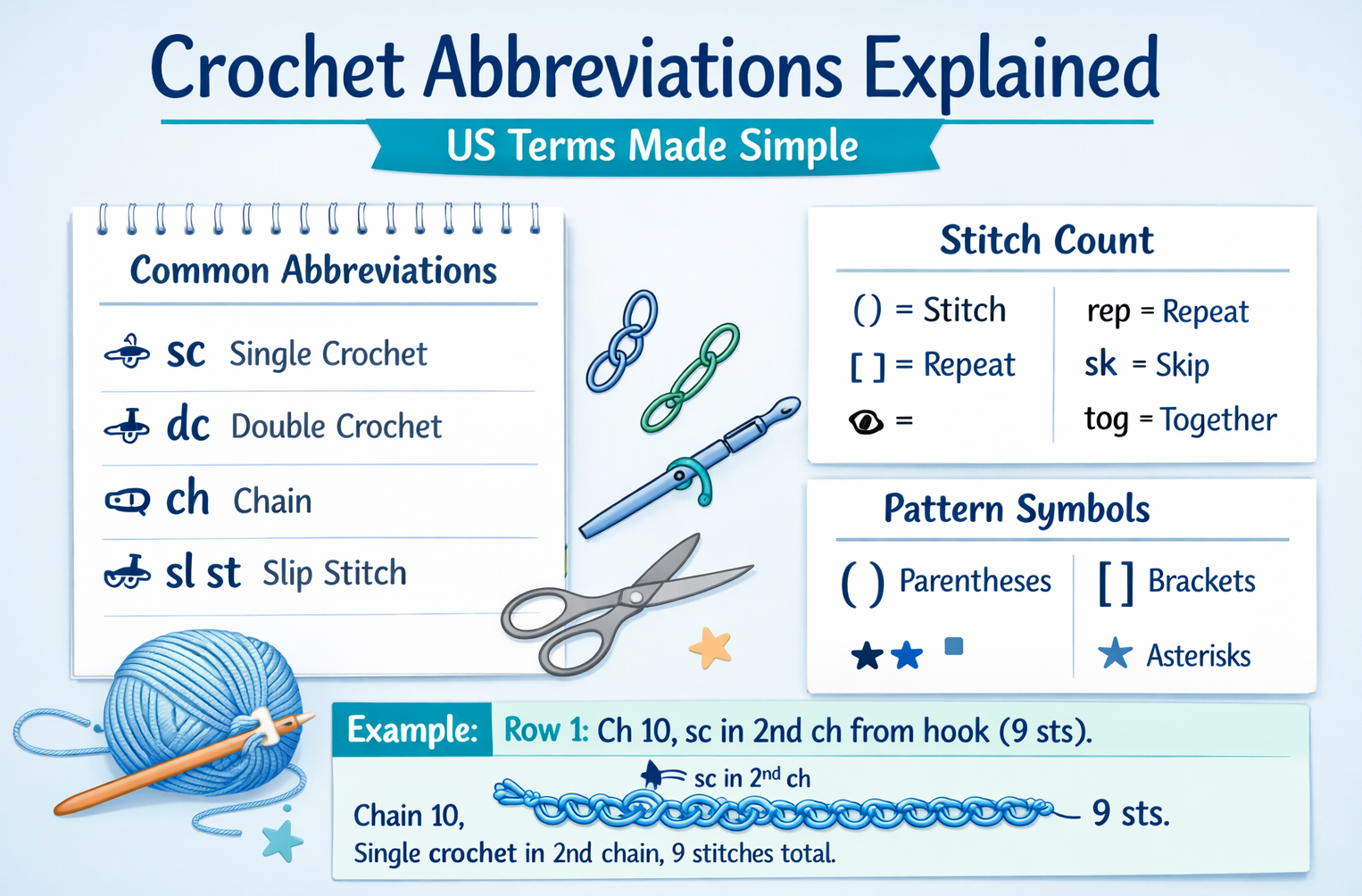
ch — Chain
The chain stitch is the foundation of most crochet projects.
What it means:
Create a loop using yarn and your hook.
Chains are often used to:
- Start a project
- Create height for the next row
- Form spaces in patterns
Example:Ch 10 → Make ten chains.
sl st — Slip Stitch
Slip stitches are used to move your hook without adding height to your work.
What it means:
Insert hook, pull yarn through the stitch and the loop on your hook.
Slip stitches are commonly used for:
- Joining rounds
- Moving to another stitch
- Finishing edges neatly
sc — Single Crochet
Single crochet is one of the most basic and commonly used stitches in US crochet.
What it means:
Insert hook, yarn over, pull up a loop, yarn over, pull through both loops.
Single crochet creates:
- Tight, sturdy fabric
- Clean, defined edges
- A beginner-friendly texture
hdc — Half Double Crochet
Half double crochet is taller than single crochet but shorter than double crochet.
What it means:
Yarn over, insert hook, pull up a loop, yarn over, pull through all loops on the hook.
This stitch works well for:
- Blankets
- Scarves
- Lightly textured projects
dc — Double Crochet
Double crochet creates a taller stitch and a more open fabric.
What it means:
Yarn over, insert hook, pull up a loop, yarn over, pull through two loops, yarn over, pull through two loops again.
Double crochet is commonly used in:
- Granny squares
- Shawls
- Clothing items
tr — Treble Crochet
Treble crochet creates long, airy stitches.
What it means:
Yarn over twice before inserting the hook.
Treble crochet is often used in:
- Decorative patterns
- Lace designs
Abbreviations for Stitch Counts and Instructions
These abbreviations help you understand how many stitches to make and where to place them.
st / sts — Stitch / Stitches
Refers to individual crochet stitches.
Example:(12 sts) → You should have 12 stitches at the end of the row.
sk — Skip
Means you do not work into the next stitch.
Example:sk 1 st → Skip one stitch.
rep — Repeat
Tells you to repeat a set of instructions.
Example:rep row 2 → Repeat row 2.
tog — Together
Means working stitches together to decrease.
Example:sc2tog → Single crochet two stitches together.
Symbols Used with Crochet Abbreviations
Patterns also use symbols to organize instructions clearly.
Parentheses ( )
Used for:
- Stitch counts
- Groups of stitches
Example:(sc, dc) in next st
Brackets [ ]
Used for repeated instructions.
Example:[sc, ch 1] 3 times
Asterisks *
Used to mark sections that repeat.
Example:*sc, dc* across
How to Read Crochet Abbreviations in Real Patterns
Let’s look at a beginner-friendly example:
Row 1: Ch 12, sc in 2nd ch from hook and across (11 sts).
Plain English explanation:
- Make 12 chains
- Skip the first chain
- Make one single crochet in each remaining chain
- Finish with 11 stitches
Reading patterns slowly and breaking them into small steps makes everything much easier to understand.
Common Beginner Mistakes with Crochet Abbreviations
1. Trying to Memorize Everything at Once
You don’t need to memorize all abbreviations. Learn the basics and look up the rest as needed.
2. Skipping the Abbreviation Section
Always read it first — some designers use custom abbreviations.
3. Mixing US and UK Terms
This is one of the most common and frustrating beginner mistakes.
How to Practice Crochet Abbreviations Without Stress
A simple practice method:
- Choose a beginner pattern
- Highlight unfamiliar abbreviations
- Keep a small cheat sheet nearby
- Crochet slowly
- Count stitches often
With consistent practice, abbreviations will start to feel natural.
Why Learning Crochet Abbreviations Changes Everything
Once you understand crochet abbreviations, you can:
- Follow thousands of free patterns
- Crochet without relying on videos
- Customize your own projects
- Build real confidence
Abbreviations are not obstacles — they are tools.
Final Thoughts: Crochet Is Simpler Than It Looks
If crochet abbreviations confuse you, it doesn’t mean you’re bad at crochet. It means you’re learning a new language — and every language takes time.
Start small. Practice often. Be patient with yourself.
Soon, those letters will stop feeling like a code and start feeling like creativity